
Welcome to Amsterdam. If you are visiting the city for the first time, the metro can be one of the easiest ways to travel quickly between key areas such as Amsterdam Noord, Station Zuid, Amsterdam Bijlmer ArenA and the south-eastern districts. It is not the only form of public transport you will use here, because trams, buses and ferries are just as important, but it is an excellent option when you want to cover longer distances without hassle. In this guide, you will find the practical tips that actually help: how the Amsterdam metro works, how to pay, how to choose the right line, where to change, and when the metro is the smartest choice for your journey.

Getting started with the Amsterdam metro
Amsterdam’s public transport network is run by GVB, and the metro forms part of the same system as the city’s trams, buses and ferries. That means you do not need to treat it as a separate network. Once you understand how to check in, check out and follow the line numbers, using the metro is straightforward.
If you want the simplest option for a short city break, it often makes sense to arrange your Amsterdam public transport pass in advance. That can be especially useful if you are arriving at Schiphol and want one ticket that covers your journey into Amsterdam as well as onward travel on GVB services in the city.
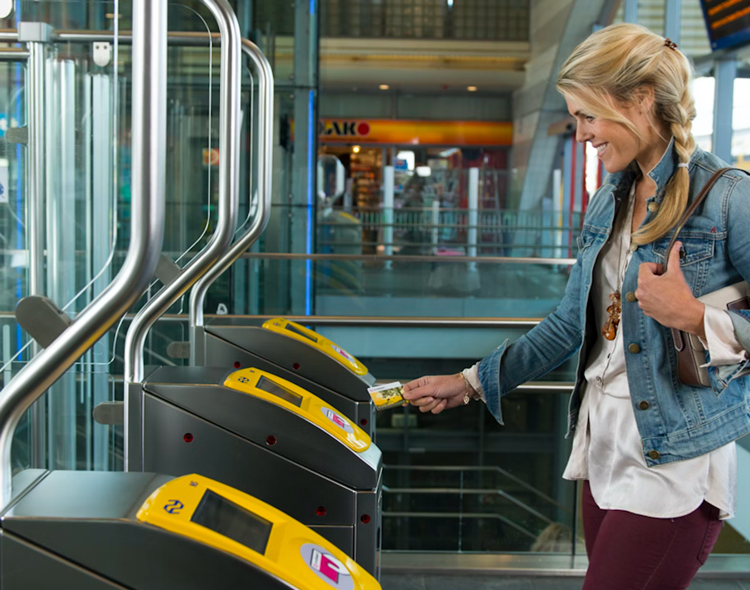
For many visitors, though, buying a separate transport card is no longer essential for every trip. In Amsterdam, contactless travel is now widely used, so if you have a debit card, credit card or mobile wallet that works for public transport, you can usually check in and out directly at the gates. That makes the whole process much easier than it used to be.
The main thing to remember is simple: always check in when you enter the station and always check out when you leave. If you forget, you may be charged incorrectly and sorting that out later is annoying when you are only in the city for a few days.
If you prefer the convenience of one product that covers your airport transfer and city transport, you can still use the Amsterdam Travel Ticket. It is a practical choice if you know you will be using public transport frequently during your stay.
How the Amsterdam metro network works
The metro system is built around five lines: 50, 51, 52, 53 and 54. On signs and maps, each line is clearly marked with its number and colour, so you do not need to memorise the whole network before you travel. In most stations, the signage is clear enough that you can work things out on the spot.
Line 52 is the Noord/Zuidlijn, the north to south line, and it is especially useful for visitors because it links Amsterdam Noord, Centraal Station, Rokin, De Pijp, Europaplein and Station Zuid. If you are staying in Amsterdam Noord or want a quick connection between the centre and the south of the city, this is the line you will probably use most.
Lines 53 and 54 run between Centraal Station and the south-east of Amsterdam. These are handy if you are going to the Johan Cruijff ArenA area, AFAS Live, Ziggo Dome or neighbourhoods further out in the south-east. If you are heading to a concert or football match, the metro is often one of the easiest ways to get there and back.
Lines 50 and 51 are useful for cross-city connections outside the historic centre. They can save time if you are travelling between outer districts or changing at major stations such as Zuid, Sloterdijk or Amstel.
One important tip: the metro is excellent for longer journeys, but it is not always the best option for the postcard part of Amsterdam. In the canal belt, Jordaan and around many central museums, trams and walking are often more practical. The metro is at its best when you want speed over distance, not when you want door-to-door access to every central sight.
Buying tickets and paying for your journey
You have a few good options, and the best one depends on how you plan to travel.
Use contactless payment for flexible travel
If you want the easiest pay-as-you-go option, contactless is ideal. You check in at the gate or card reader with the same bank card, phone or smartwatch, and you must use that exact same method again to check out. Do not check in with your phone and then check out with the physical card linked to it, because the system can treat that as two different payment methods.
Choose a day ticket or travel pass for convenience
If you expect to use public transport a lot in one day or over several days, a dedicated ticket can be better value and simpler to manage. This is where an Amsterdam public transport pass can make sense, especially for first-time visitors who want everything sorted before arrival.
Do not assume the metro goes to Schiphol
This is one of the most common mistakes. Schiphol Airport is connected to Amsterdam mainly by train and by the Amsterdam Airport Express bus, not by the metro. If your transport product includes airport travel, that is usually because it covers the train or airport bus as well as local GVB transport in the city.
How to read the signs and find the right platform
Amsterdam metro stations are generally easy to navigate. At the entrance gates, you will usually see route maps, line diagrams and platform signs. The most useful detail to follow is the final destination of the train, because that tells you which direction the service is travelling.
When you reach the platform, check the electronic display boards. These usually show the line number, the train’s destination and the next departures. If you are unsure, compare the destination on the platform sign with the station names on the network map. That is often quicker than staring at your phone while people move around you.
If you need help, look for major interchange stations such as Centraal Station, Zuid, Amstel and Bijlmer ArenA on the map before you set off. Once you know your change point, the rest of the journey becomes much easier to follow.
Boarding and riding the metro
When the train arrives, let passengers get off first before you board. Inside, you will find standing areas, poles and seats, and on busier services it is normal to stand for short trips. The metro is usually clean and efficient, and journeys are often quicker than travelling above ground through traffic.
Keep your belongings close, especially during busy periods, and move away from the doors if you are staying on for several stops. Like in any major city, a bit of awareness goes a long way.
If you are travelling with luggage, try to avoid the busiest commuter moments if possible. Amsterdam’s metro is manageable with bags, but changing lines and navigating gates is much easier when the platforms are quieter.
When the metro is the best choice for tourists
The metro is particularly useful for some journeys and less useful for others. Knowing the difference helps you save time.
Use the metro for Amsterdam Noord
If you are staying in Amsterdam Noord or visiting areas across the IJ, metro line 52 is one of the fastest ways to reach the city centre and Station Zuid. It is far quicker than many visitors expect.
Use the metro for events and large venues
For the Johan Cruijff ArenA, AFAS Live and Ziggo Dome area, the metro is often one of the smartest ways to travel. It is direct, frequent and well suited to large crowds before and after events.
Use the metro for fast cross-city travel
If you need to get from the south of the city to the centre, or from Centraal Station to De Pijp or Zuid, the metro can save a lot of time compared with trams.
Do not rely on the metro alone for the classic city centre
If your day is focused on Jordaan, the Nine Streets, the Anne Frank House, Dam Square, Museumplein or the canal belt, you will probably combine metro with tram or walking rather than use metro only. For example, the Anne Frank House is not directly on a metro stop, and the Van Gogh Museum is usually easier to reach by tram, on foot from nearby districts, or by combining metro with a short onward connection.
Transfers and connections
Changing between metro lines is usually simple, especially at the larger stations. Follow the overhead signs carefully and give yourself a little extra time if it is your first day in the city. Stations such as Centraal Station and Zuid can feel busy, but the wayfinding is generally good.
The nice thing about Amsterdam’s transport system is that the metro connects smoothly with trams, buses, ferries and trains. That means you do not need to think in strict categories. If the metro gets you most of the way and a tram finishes the journey more neatly, that is often the best combination.
Journey planning apps can help, but station signage is usually reliable enough that you can also travel confidently without overcomplicating things. Once you have done one or two journeys, the whole system starts to feel very intuitive.
Useful tips to avoid common mistakes
Always check in and check out, even if the gates are open or the station looks quiet.
Always use the same card or device for both check-in and check-out.
Do not assume every major attraction is best reached by metro. In central Amsterdam, trams and walking are often better.
Do not confuse airport travel with metro travel. Schiphol is not part of the metro network.
If you are heading to a concert, match or event, leave a little extra time for crowds on platforms after the event ends.
Final thoughts on using the Amsterdam metro
The Amsterdam metro is not huge compared with systems in cities like London or Paris, but that is actually part of its charm for visitors. It is efficient, clear and easy to understand, and it works best as part of Amsterdam’s wider public transport network rather than as a stand-alone system.
If you use it for the journeys where it really shines, such as Amsterdam Noord, Station Zuid, the south-east and fast cross-city travel, it can make your trip much smoother. Combine it with trams, ferries and a bit of walking, and you will be able to get around Amsterdam with very little stress.
Get your Amsterdam public transport pass here