
Getting around Amsterdam is easier than it looks once you know how the system works. The city has trains, trams, buses, metros, ferries and of course bicycles, and together they make it possible to get almost anywhere quickly. For most visitors, the biggest challenge is not the transport itself, but choosing the right option for each trip and understanding which ticket to use.
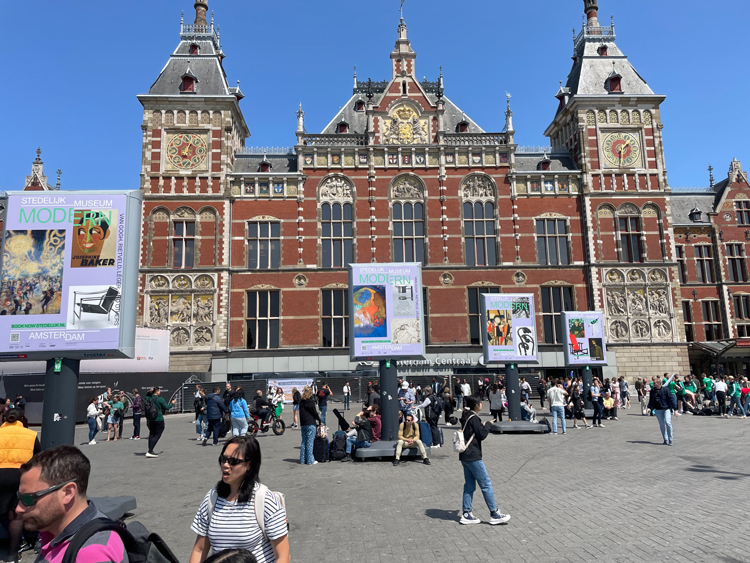
If you are staying mainly in the city centre, you will probably use the tram most often. If you are travelling from Schiphol or making longer journeys across the Netherlands, the train is usually the best choice. The metro is especially useful for faster trips to areas outside the centre, while buses fill in the gaps where trams and metro do not go. The ferries behind Amsterdam Central are free and very handy if you want to reach Amsterdam Noord. And if you feel confident in traffic, renting a bike can still be one of the nicest ways to explore the city.
For planning your route, the NS app is still a very useful tool, especially if you are combining trains with local transport or travelling beyond Amsterdam. Google Maps also works well for most visitors. In practice, that means you can check the fastest route in a few seconds and see straight away whether you need a tram, metro, train or bus.
Tip: Check Amsterdam & Region Travel Ticket options if you want to combine Amsterdam with places such as Haarlem, Zaanse Schans or Volendam.
How to pay for public transport in Amsterdam
The easiest way to use public transport in Amsterdam now is often simply to check in and out with the same contactless debit card, credit card or phone. You can also use the new OV-pas; for most visitors, this is the simplest option, and the old OV-chipkaart is being phased out.
That said, a travel pass can still be the better option if you know you will be making several trips a day. For transport within the city itself, a GVB day or multi-day ticket is usually the most convenient choice. If you are arriving at Schiphol and want your airport transfer included as well, an Amsterdam Travel Ticket can make more sense. If you also plan to explore the wider area around Amsterdam, an Amsterdam & Region Travel Ticket is often the better fit.
The main thing to remember is this: not every Amsterdam transport ticket covers every operator. A GVB ticket is great for Amsterdam trams, metro and city buses, but it does not automatically include the train from Schiphol. Schiphol is not on the metro, so the normal airport links are the train or the Amsterdam Airport Express (bus 397/N97). Always check what your ticket covers before you buy it.
From Schiphol Airport to Amsterdam city centre

Most visitors arrive at Schiphol Airport first, so this is usually the first transport decision you have to make. The good news is that Schiphol is extremely well connected to Amsterdam.
Train from Schiphol
The train is usually the fastest and easiest way to get from Schiphol to Amsterdam Centraal. The station is directly underneath the airport, so you simply follow the signs from the arrivals hall down to the platforms. Trains to Amsterdam run frequently and the journey to Amsterdam Centraal is short, making this the best option for many travellers, especially if you are staying near Central Station, Sloterdijk, Zuid or Lelylaan.
If your hotel is not close to Amsterdam Centraal, check before you board whether another Amsterdam station is actually more convenient. In some cases, getting off at Amsterdam Zuid or Amsterdam Lelylaan can save you time and an extra transfer.
Check Schiphol to Amsterdam train ticket options
Bus 397 from Schiphol
If you are staying around Museumplein, Leidseplein or the south-west side of the city centre, the Amsterdam Airport Express can be a very practical alternative. This is bus 397, and at night the route is covered by N97. It does not go to Amsterdam Centraal, so it is best for visitors whose accommodation is closer to the bus route than to the train stations.
The bus leaves from the Schiphol bus platform area and is popular with travellers who want a direct connection without first taking the train into the centre. It is also a useful option if you have already checked where your nearest stop is and know that the bus will drop you closer to your hotel.
Taxi or pre-booked transfer
A taxi is the easiest door-to-door option, but also one of the most expensive. If you prefer comfort or are arriving with a lot of luggage, a pre-booked transfer can be the most relaxed way to start your trip. It also helps if you arrive late at night or simply do not want to deal with train platforms, stops and transfers after a flight.
Check private airport transfer options
More information about airport transfers
Trains in Amsterdam
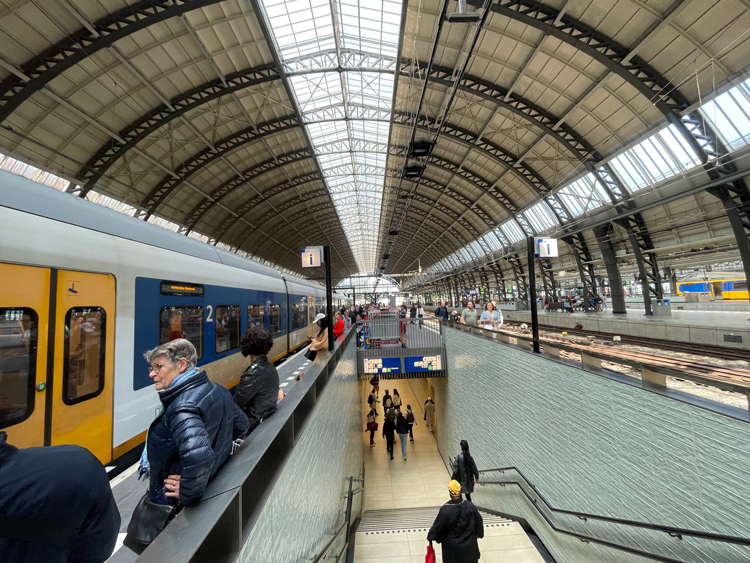
The train is the best option for longer distances, airport transfers and day trips to other Dutch cities. Within Amsterdam itself, the train is useful if you are travelling between the larger stations, but for short inner-city journeys the tram or metro is often more practical.
Amsterdam Centraal is the city’s main station and the one most visitors will use first. Other important stations include Amsterdam Zuid, Sloterdijk, Lelylaan, Amstel and Bijlmer ArenA. These stations connect easily to metro, tram or bus services, so it is worth checking which station is closest to your accommodation instead of assuming that Amsterdam Centraal is always the best arrival point.
If you travel by train, you can buy a ticket in advance, use the NS app or simply check in and out with your contactless card. At many stations you pass through gates, so make sure you use the same card or device for both check-in and check-out. That matters whether you use a bank card, phone or paper ticket.
Check Amsterdam & Region Travel Ticket availability
The 2026 prices are: Amsterdam Travel Ticket €20 / €27 / €34 for 1 / 2 / 3 days, and Amsterdam & Region Travel Ticket €23 / €34 / €44 for 1 / 2 / 3 days.
Metro in Amsterdam
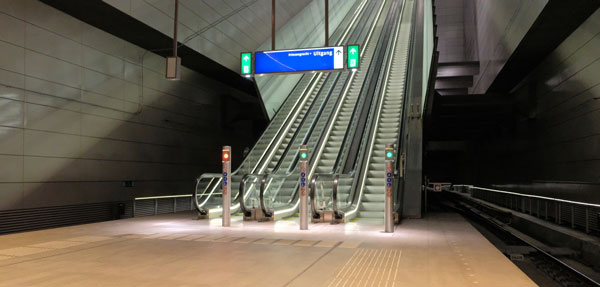
The metro is ideal for getting around quickly, especially if you are staying outside the historic centre or heading to places such as Amsterdam Zuid, RAI, Bijlmer ArenA, Amstel or Noord. Unlike the tram, which is better for short city-centre trips, the metro covers longer distances faster and with fewer delays from street traffic. Schiphol is not on the metro, so for the airport you should use the train or the Amsterdam Airport Express instead.
Amsterdam has five metro lines: 50, 51, 52, 53 and 54. For many visitors, the most useful one is line 52, also known as the North/South line, which connects Amsterdam Noord with the city centre and Amsterdam Zuid. It is one of the quickest ways to move between these areas. The other lines are especially useful for reaching business districts, residential areas and larger event venues.
For tourists, there is no real need to memorise every stop. It is much more useful to know when the metro is the smarter option than the tram. If you want to reach Amsterdam Noord, Zuid, RAI or the Johan Cruijff ArenA area efficiently, the metro is often the best choice.
If you use the metro, remember that you normally enter through gates at the station, so you must always check in and out. That can be with a valid ticket or with the same contactless payment method for the whole journey.
More information about the Amsterdam metro
Tip: Check GVB public transport ticket options if you want unlimited travel on Amsterdam trams, buses and metro. In 2026, the usual GVB pay-as-you-go fare is €1.16 plus €0.217/km, a 1-hour ticket costs €3.40, and a day ticket costs €10.
- 2 days: €16
- 3 days: €21.50
- 4 days: €27.50
- 5 days: €34
- 6 days: €39
- 7 days: €43
Trams in Amsterdam
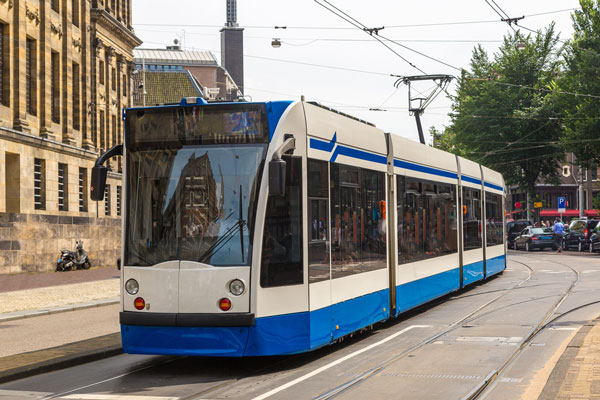
The tram is the classic Amsterdam transport option and for many visitors it will be the one you use most. Trams are especially useful in and around the city centre, where they connect major areas such as Dam Square, Museumplein, Leidseplein, De Pijp and Amsterdam Centraal.
If you are sightseeing, the tram is often the most convenient way to move between neighbourhoods without having to walk the entire distance. It is also a good choice if you do not want to cycle through busy traffic or if the metro does not stop close enough to where you need to be.
When you board a tram, check in at the card reader and remember to check out when you leave. If you are using a paper or mobile ticket, keep it ready. If you are using a bank card or phone, always use the same one for the whole trip. In general, buying your ticket in advance is the easiest option, because it saves time and avoids confusion once you are already on board.
More information about taking the tram in Amsterdam
Tip: Check Amsterdam travel pass options if you want one ticket that also helps for trips beyond the centre.
Buses in Amsterdam
The bus is useful when the tram or metro does not go where you need to be, especially in outer neighbourhoods, residential areas and at night. For most tourists, buses are not the first choice in the historic centre, but they become much more useful once you travel farther out or stay in an area without a tram stop nearby.
Amsterdam’s bus network is well connected to the rest of the public transport system, which means changing from bus to tram, metro or train is usually straightforward. Just remember that every new vehicle or station entry requires a check-in and later a check-out.
One important practical point: buses do not stop automatically everywhere. If you want to get off, press the stop button in time. That is standard in Amsterdam and makes the ride faster for everyone on board.
If you want a sightseeing-style experience instead of normal public transport, there are also hop on hop off buses, but for many visitors the regular GVB network is cheaper and more practical.
Check Amsterdam public transport ticket options
Free ferries in Amsterdam
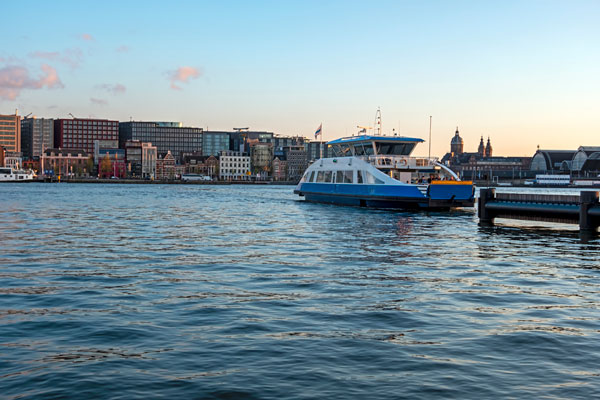
The ferries behind Amsterdam Centraal are one of the easiest and nicest ways to cross the IJ. They are part of daily life for locals, but for visitors they are also a great way to reach Amsterdam Noord without paying extra.
The most popular ferry is the short crossing to Buiksloterweg, which is useful if you want to visit the A’DAM Tower, Eye Filmmuseum or simply explore Noord. There are also ferries to places such as NDSM and IJplein, which are worth knowing about if you want to see a different side of the city.
The crossing itself is short, but the view back over the water toward Central Station is always fun, especially on a clear day. If you have never taken the ferry in Amsterdam before, it is one of those small city experiences that is both practical and memorable.
Taxis in Amsterdam
Taxis are available in Amsterdam, but for most visitors they are not the most efficient way to move around the centre. The city can be busy, streets are narrow, and traffic often makes a taxi slower than you expect. On top of that, taxis are expensive compared with public transport.
If you do want a taxi, use an official taxi rank, ask your hotel to call one, or arrange a transfer in advance. Do not rely on the idea that you can easily flag one down everywhere in the centre like in some other big cities. In Amsterdam, public transport is usually the smarter option for everyday trips.
Exploring Amsterdam by bike
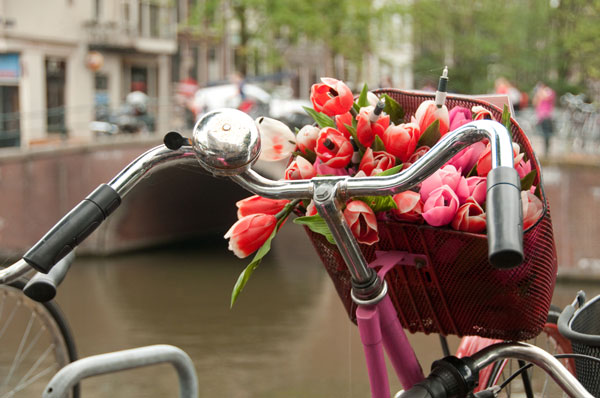
No guide to Amsterdam transport would be complete without the bicycle. Cycling is part of everyday life here, and if you are comfortable on a bike it can be one of the best ways to see more of the city in less time.
That said, Amsterdam is not the best place for nervous cyclists to start. The centre can be hectic, locals cycle fast and confidently, and you need to pay close attention to trams, scooters, pedestrians and other bikes. If you are not used to this kind of traffic, it is better to ride in quieter areas first or choose a guided bike tour instead of heading straight into the busiest streets.
A bike is particularly nice for exploring neighbourhoods outside the busiest centre, heading through the parks, or combining your visit with a more local feel of the city. If that sounds like your style, renting a bike can be a great addition to your trip.
More information about bike rental in Amsterdam
Check Amsterdam bike rental and tour options
Which transport option is best for your trip?
If you want one simple rule, use the tram for the centre, the metro for speed, the train for Schiphol and longer distances, the ferry for Amsterdam Noord, and the bike if you are confident in traffic. That already covers almost every situation most visitors run into.
Amsterdam’s public transport network is good enough that you rarely need a car, and in many cases a car only makes your trip more complicated because of traffic, parking costs and narrow streets. For a city break, public transport plus walking is usually the easiest combination by far.
Once you know that, Amsterdam becomes a very easy city to navigate. Plan your route, pick the right ticket or payment method, and you will be able to get around smoothly from the moment you arrive.
If you are also visiting several paid museums or attractions, compare the Amsterdam city passes. The I amsterdam Total Experience includes GVB transport, while attraction-focused passes such as Go City work differently.