
If you are staying in the centre of Amsterdam, you will probably use trams, the metro, ferries, walking and the occasional taxi more often than the train. But the train becomes very useful the moment you arrive at Schiphol Airport, stay outside the historic centre, or want to make an easy day trip to places such as Zaanse Schans, Haarlem, Rotterdam or other cities in the Netherlands. This guide explains in a simple way how train travel in Amsterdam works, where to buy tickets, which pass makes sense for tourists, and what you need to know before you step onto the platform.
For many visitors, Amsterdam Centraal is the main starting point for train journeys. It is the city’s busiest rail hub, easy to reach from the centre, and the station most travellers will use for airport transfers and day trips. Other Amsterdam stations such as Amsterdam Zuid, Sloterdijk, Lelylaan and Amstel can also be useful depending on where you stay, but if you are exploring as a tourist, Amsterdam Centraal is usually the most practical place to begin.
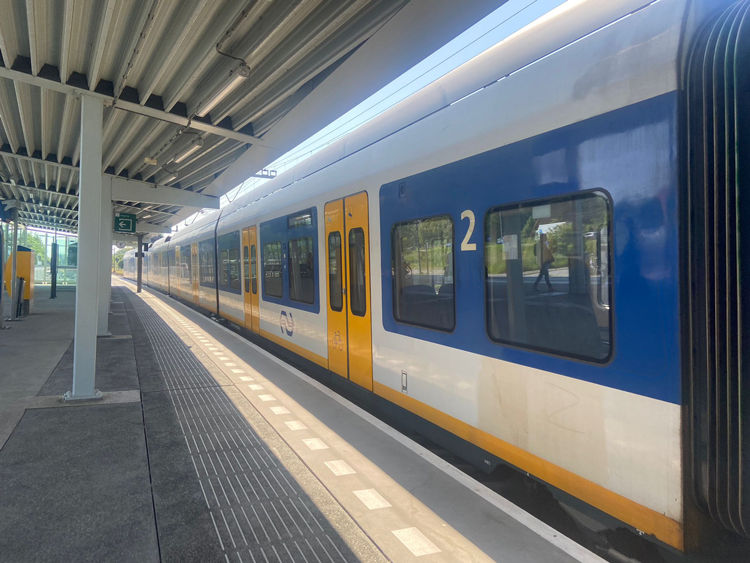
From Schiphol to Amsterdam Centraal by train
If you fly into the Netherlands, you will arrive at Amsterdam Schiphol Airport. From there, the train is one of the quickest and easiest ways to reach the city. The railway station is directly below the airport terminal, so you do not need a shuttle bus or taxi just to get into Amsterdam.
The journey from Schiphol to Amsterdam Centraal is short and straightforward. Trains run frequently throughout the day, and once you arrive at the station you can continue on foot, by tram, metro, ferry or taxi depending on where your hotel is located. If you are travelling with luggage, this is usually the most practical option because it is fast, predictable and much cheaper than a private transfer into the city centre.
If you prefer to arrange this before you land, you can book your ticket in advance below.
Do you need a ticket, a pass or just your bank card?
This is where many tourists overcomplicate things. In practice, you have three easy options.
1. Use contactless payment
For many visitors, the easiest option is simply to travel with a contactless debit card, credit card or phone. In the Netherlands, this works through the public transport system used across trains, metros, trams and buses. You tap in at the start of your trip and tap out at the end with the same card or device. This is a good choice if you only plan to make a few train trips and do not want to buy a separate pass.
2. Buy a regular train ticket
If you know exactly where you want to go, a standard one-way or return ticket is also fine. This works well for a direct airport transfer or a single day trip from Amsterdam to another city. You can buy these at the station or in the NS app.
3. Buy a regional travel pass
If you want to combine Amsterdam with places around the city and use multiple forms of public transport in a short period, a travel pass can save money and hassle. This is especially useful if you are staying for one to three days and want the freedom to jump between train, bus, tram and metro without buying separate tickets each time.
The most practical train and public transport pass for tourists
If you want to explore both Amsterdam and the surrounding area, the Amsterdam & Region Public Transport Pass is often the most convenient option. It is aimed at travellers who want flexible, unlimited travel instead of dealing with separate tickets all day.
With this pass, you can use public transport in Amsterdam itself and also travel to places in the wider region. That makes it useful for visitors who want to combine the city with day trips such as Zaanse Schans, Volendam, Haarlem or other nearby destinations. It can also be handy if your accommodation is not in the centre and you expect to move around a lot.
The pass is available for one, two or three consecutive calendar days. Once activated, it remains valid for the selected period. You must always check in when you start a trip and check out when you finish, including when you switch between transport operators. That sounds more complicated than it is. In reality, you just tap the card at the readers as you enter and leave each train, metro, tram or bus journey.
If you are arriving by plane and want one simple product that covers more than just the airport transfer, this can be a strong option.
Order here your Amsterdam & Region Public Transport Pass:
Buying train tickets at the station
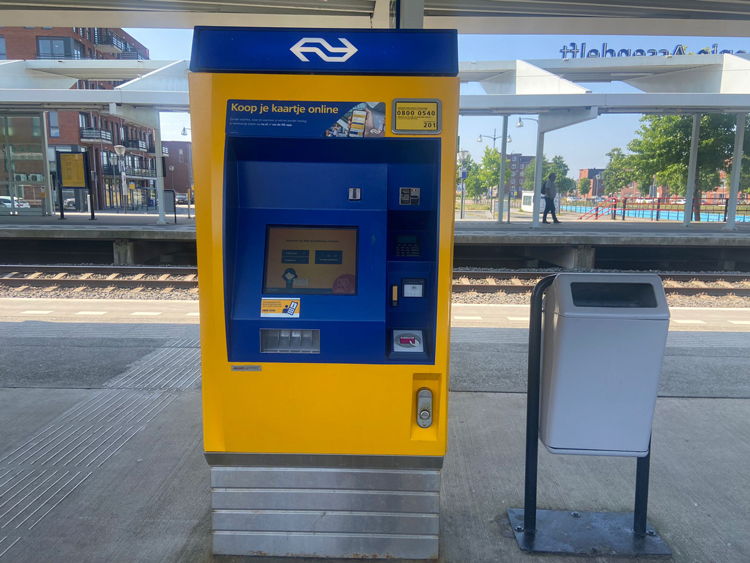
If you prefer to buy your ticket when you arrive, that is completely normal in the Netherlands. At most stations you will find yellow-and-blue NS ticket machines where you can buy a one-way ticket, return ticket or other products. The machines are easy to spot and are designed for self-service, which is why many travellers never need to stand in line.
At larger stations such as Amsterdam Centraal and Schiphol, there are also service desks or ticket shops where staff can help if you have questions about your route, your ticket or your public transport card. That is useful if you are arriving tired after a flight, travelling with children, or combining several forms of transport in one day.
The best approach is simple: use the machine or the app if you already know your journey, and go to the service desk if you want help or reassurance.
Buying your ticket online in the NS app
If you like to organise things before you travel, the NS app is useful. You can check routes, departure times, platform information and ticket options in one place. The app is available in English, which makes it much easier for international visitors than trying to figure everything out while standing at a busy station.
Buying online can be especially helpful for airport arrivals, early departures and day trips. It saves time at the machine and gives you a clearer idea of your route before you leave your hotel. If you already know that you are going from Amsterdam to Schiphol, Zaandijk Zaanse Schans, Haarlem or Rotterdam, arranging it in advance can make the day feel much smoother.
Check in and check out
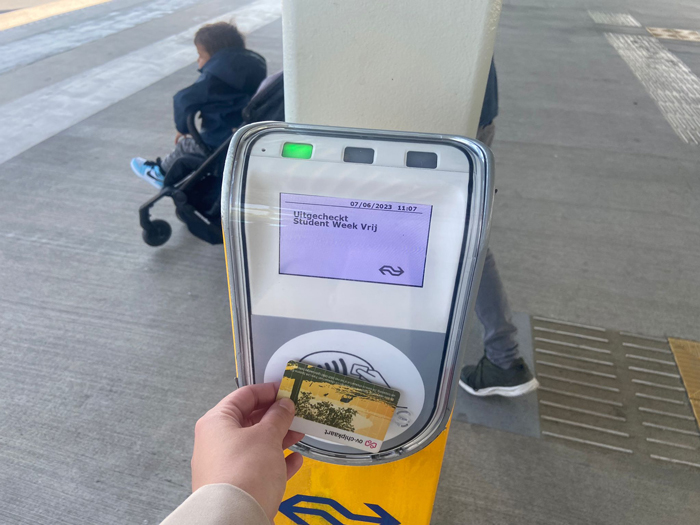
This is the one part visitors should not ignore. Whether you travel with a pass, an OV-chipkaart or a contactless bank card, you need to check in at the start of your trip and check out at the end. At some stations you will pass through gates. At others you will tap in and out using free-standing poles.
Always use the same card or the same phone for both actions. So if you checked in with your debit card, do not check out with Apple Pay on a different device. If you switch between train and another operator, make sure you finish one journey properly before starting the next. Once you do it once or twice, it becomes very easy.
Useful discounts and practical extras
If you are travelling together, it is worth checking whether a group discount makes sense for your route. Dutch railways offer discounted group travel in off-peak hours, which can be useful for couples, friends or families making a longer trip by train. For tourists, this is most helpful when everyone is travelling together on the same route at the same time.
You can also take a bicycle on many Dutch trains, but this is not as flexible as bringing small luggage. A separate bike ticket is required for a regular bicycle, and bikes are generally only allowed outside peak hours. If the train is busy, space can be limited, so do not assume you will always have room. Folding bikes are often easier because they take up less space.
Children can often travel more cheaply than adults, but the best option depends on age and route. If you are travelling as a family, it is worth checking this in the app or at the ticket machine before you buy.
What Dutch trains are like inside
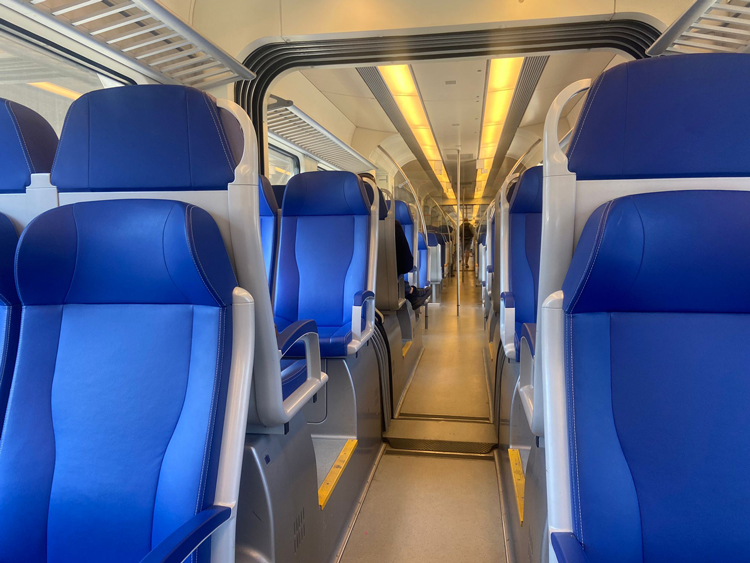
Travelling by train in the Netherlands is usually simple, clean and comfortable. Most visitors use second class, which is more than good enough for short and medium-length journeys. First class exists, but for typical tourist trips there is usually little reason to pay extra unless you specifically want a quieter carriage.
Inside the train you will usually find a mix of seating styles. Some areas have seats facing each other around a table, some have airline-style rows, and some are better suited to couples or solo travellers. On many trains, digital screens show the next stop and route information clearly, which is very helpful if you are unfamiliar with Dutch station names.
You may also find charging points for phones and laptops, especially on newer rolling stock. Wi-Fi is available on some trains, although it is best treated as a bonus rather than something to depend on for work or video calls. For tourists, the most important point is that the system is clear, well signed and generally easy to use even on your first trip.
By train to Zaanse Schans without a tour
If you want to visit the Zaanse Schans independently, the train is one of the easiest ways to do it. You do not need a guided excursion if you prefer to explore at your own pace.
 |
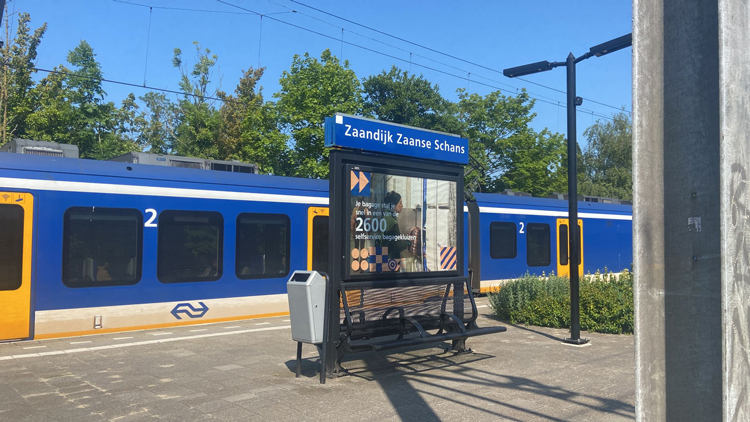 |
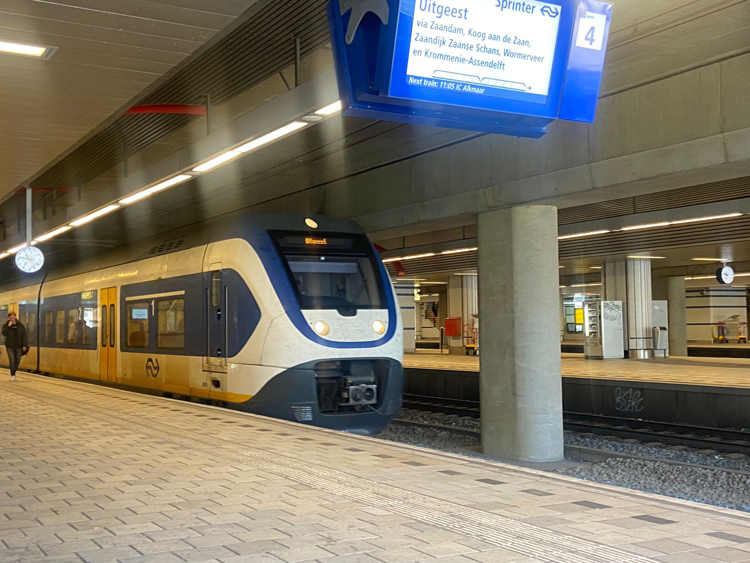
From Amsterdam Centraal, take the train to Zaandijk Zaanse Schans. The ride is short, and once you arrive you can walk to the area in around fifteen to twenty minutes depending on your pace and which entrance or attraction you are heading for. The route is straightforward for most visitors, and signs in the area help once you are closer.
The train is a good choice for travellers who want freedom. You can leave early, arrive before the bigger crowds, stay for as long as you want and return when it suits you. If you prefer not to walk from the station, you can continue by bus, taxi or bike, but many visitors simply do the final stretch on foot.
If you are planning to combine Zaanse Schans with other places around Amsterdam on the same day, a regional travel pass can be more convenient than buying separate tickets for every part of the journey.
Final tip for first-time visitors
If you are only making one or two train journeys, contactless payment or a regular ticket is usually enough. If you are doing several trips in and around Amsterdam, a regional pass can make the day much easier. And if you are unsure at the station, do not panic. Dutch stations are well organised, the signs are clear, and there is almost always a machine, gate, information board or staff member nearby to point you in the right direction.
Once you understand the basic rhythm of Dutch train travel, choose your route, tap in, get on the right train, and tap out at the end, it becomes one of the easiest parts of travelling around Amsterdam and beyond.